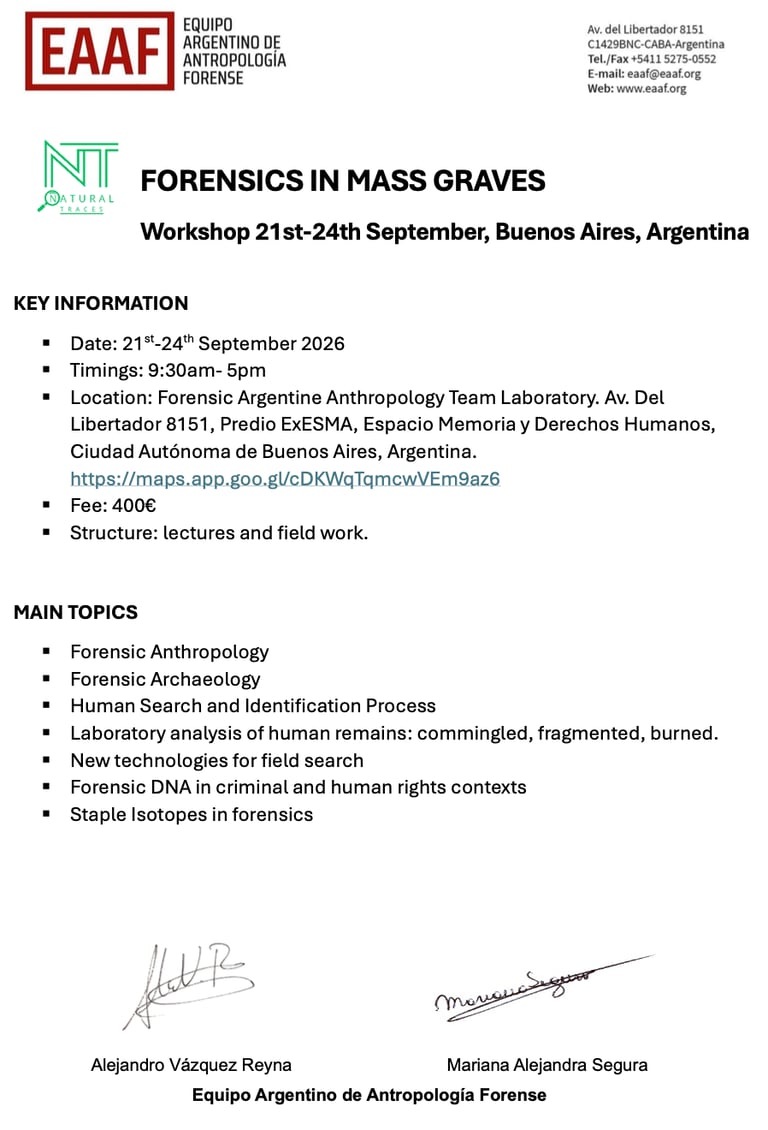
Introduction to the Forensics of Mass Graves
A workshop
21-24 September 2026
EAAF Laboratories and Headquarters at the Memory and Human Rights Space (former ESMA)
Equipo Argentino de Antropología Forense (EAAF)
Av. del Libertador 8151
Buenos Aires, Argentina

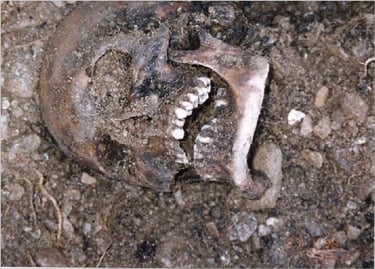
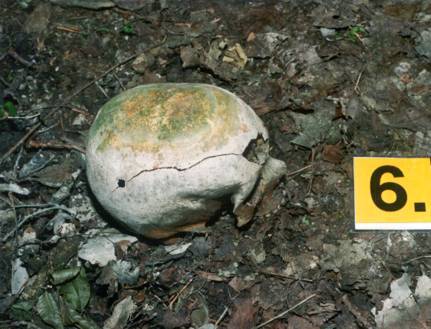
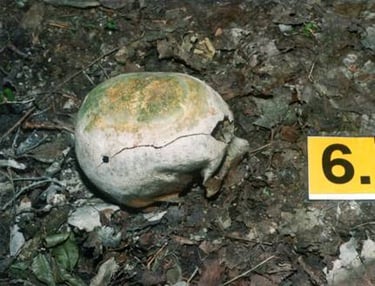
Why would an Argentine team be relevant for me? I likely will be working somewhere in Europe, not in South America. The EAAF has been working in Africa, Asia, the Americas, Europe, and Oceania.
For example:
History of the EAAF
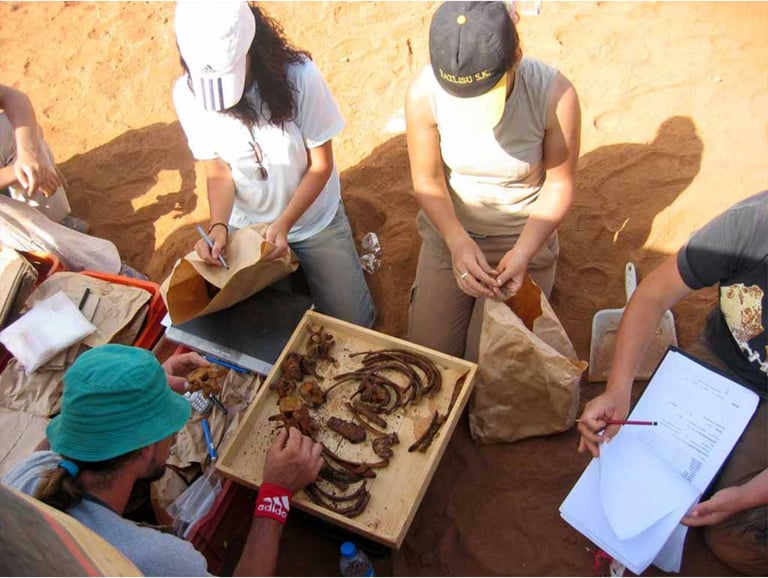
EAAF’s International Center for Training in Forensic Sciences has the objective of strengthening local and regional capacities by promoting the application of forensic sciences under international standards in cases of political, ethnic, social and religious violence, in the investigation of femicides, in the identification of victims of macrocriminality, and in the search for missing migrants. Since its founding in 1984, EAAF has been committed to sharing its expertise by training professionals in Argentina and other countries around the world. Early on, EAAF carried out this objective by promoting the creation of other teams of forensic anthropologists and training many of their founding members. Later, it began a more systematic training process by organizing lectures, courses, seminars and workshops focused on forensic sciences. Following these guiding principles, in 2012 EAAF created the “African School of Humanitarian Forensic Action” in South Africa. This school is a space for permanent training in Africa, strongly focused on investigations into cases of human rights violations. The school provides yearly trainings and over time has become a benchmark, not only in Africa, but also for professionals working in Asia. Since 2017, EAAF has replicated the African training experience in Latin America, creating the first Latin American School of Forensic Sciences and Human Rights in order to strengthen the application of forensic sciences within medical, legal and humanitarian frameworks, to develop local capacities and to promote the use of international forensic standards in different investigations being conducted in Latin America countries. During its training courses, EAAF emphasizes the interdisciplinary nature of forensic investigations as well as the need to apply a comprehensive approach to each case and combine several lines of evidence with a focus on the proper search and recovery of bodies and the application of genetics and anthropological analysis for identification purposes. It also instructs on the use of physical evidence as an important and valuable component in humanitarian investigations and judicial proceedings, thus contributing to the training of professionals in the search for truth and justice for victims’ families and to the prevention of future human rights violations.
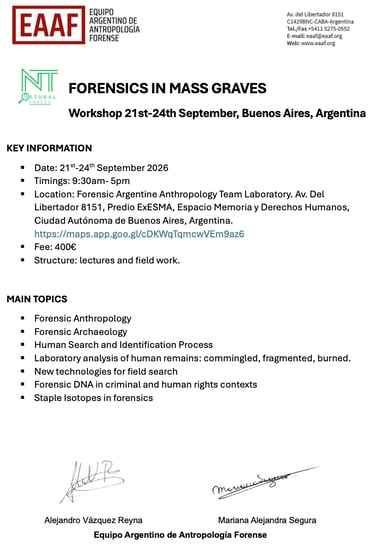
The fee includes coffee breaks and lunch, PPE (personal protective equipment), and consumables for the different practical activities.


download pdf of timetable
If you have any special requirements for the lunch, like allergies, vegetarian option, and so on, please contact the EAAF directly
through e-mail lpisso@eaaf.org
or WhatsApp 00 54 9 11 369 935 98
Please use this contact also for questions regarding questions of paying the workshop fee of € 400, ideally in cash at site.
Logistics


Place
Laboratorios y sede central de la EAAF en Espacio Memoria y Derechos Humanos (ex ESMA)
EAAF Laboratories and Headquarters at the Memory and Human Rights Space (former ESMA)
Equipo Argentino de Antropología Forense (EAAF), Centro International de Capacitación de Ciencias Forense
Argentine Forensic Anthropology Team, International Center for Training in Forensic Sciences
Av. del Libertador 8151
Buenos Aires, Argentina
https://maps.app.goo.gl/cDKWqTqmcwVEm9az6
The workshop will run from 09:00 to 17:00 everyday.